For a Toronto couple buying a $698,000 condo, the mortgage could be about $3,044 a month. But that would cover only part of the household’s housing budget.
Add condo fees, property tax, an insurance allowance and money set aside for repairs, and the monthly amount becomes approximately $4,226. Electricity and internet billed separately would come on top.
That is $1,182 beyond the mortgage.
Condo fees are a substantial part of that gap. But the lesson from these examples is more specific than “high fees make condos a bad buy”: a lower purchase price can still produce a lower monthly bill, even when the fee is higher. Buyers need to calculate both together, then check whether the building’s finances could change the answer.
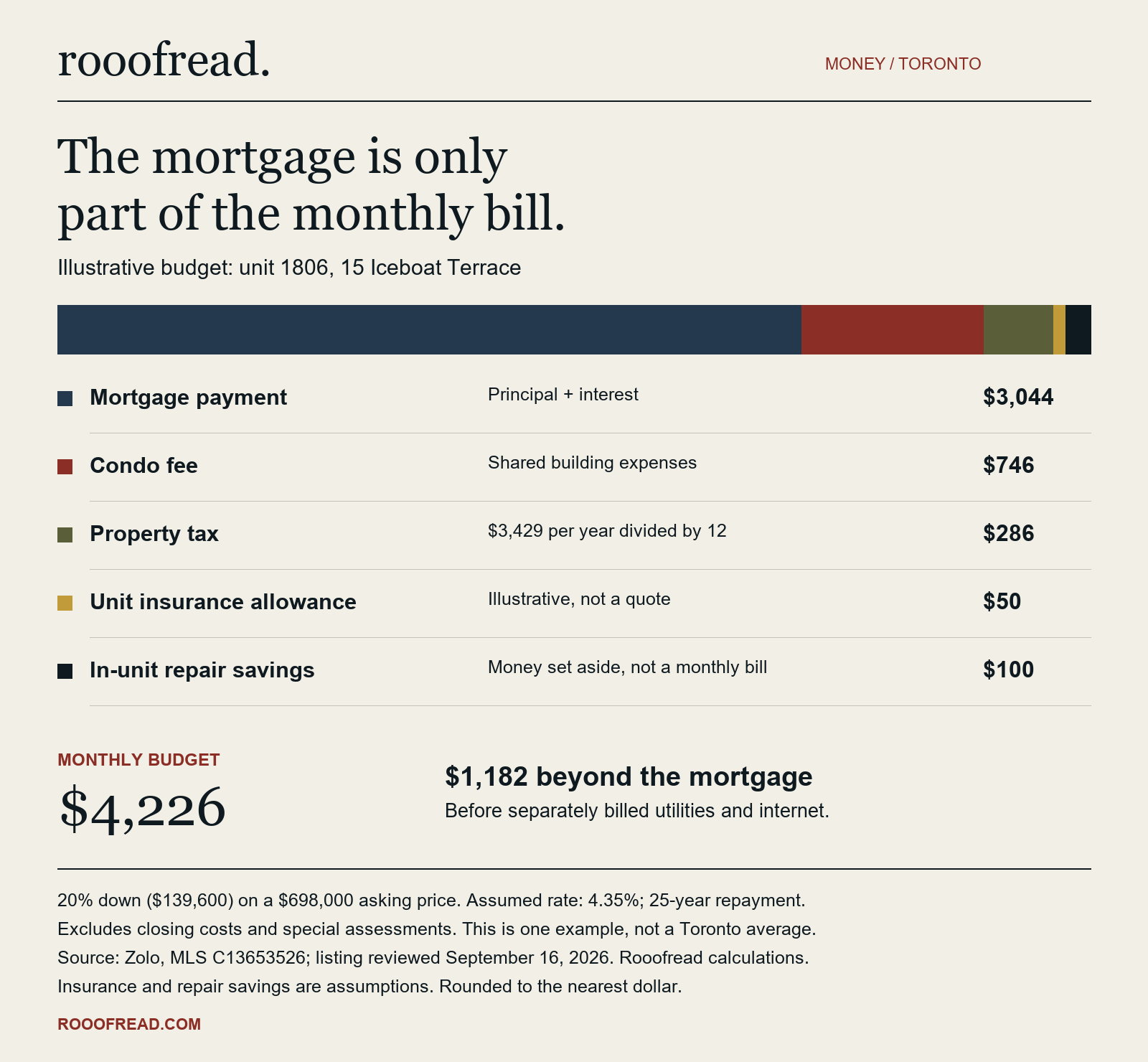
What the couple would actually pay
Consider a hypothetical couple looking at unit 1806 at 15 Iceboat Terrace. Its listing shows a $698,000 asking price, a $746 monthly condo fee and $3,429 in annual property taxes. These are advertised figures reviewed September 16, 2026, not a completed sale or an assessment of the building’s finances. Property listing.
With 20% down, the couple would contribute $139,600 and borrow the remaining $558,400.
At an assumed 4.35% interest rate, repaid over 25 years, that loan produces a monthly payment of approximately $3,044. The rate is a calculation assumption, not a mortgage offer.
Their budget would look like this:
| Monthly item | Amount | What it means |
|---|---|---|
| Mortgage payment | $3,044 | Interest plus repayment of the amount borrowed |
| Condo fee | $746 | The unit’s contribution toward shared building expenses |
| Property tax | $286 | The listed $3,429 annual tax divided by 12 |
| Unit insurance | $50 | An illustrative allowance to replace with an actual quote |
| Repair savings | $100 | Money set aside for repairs inside the unit, not a bill due every month |
| Total monthly allocation | $4,226 | Before separately billed utilities and internet |
The mortgage includes money that reduces the debt. Repair savings remain the couple’s money until spent. This table measures the cash they need to allocate each month, rather than treating every dollar as an unrecoverable expense.
The down payment and closing costs are separate. Land transfer taxes, legal costs, adjustments and moving expenses do not disappear because the monthly budget works.
Why the condo fee does not cover everything
Condo fees help fund the corporation’s operations and reserves for major repairs to shared property. They can include services such as heating and water, but the exact inclusions depend on the building. Condominium Authority of Ontario: resale condos.
The Iceboat listing reports heat, water, common elements, building insurance and parking as included. Buyers should confirm those details in the documents.
Building insurance also does not replace the owner’s own coverage. Personal belongings, improvements and possible responsibility for a corporation’s insurance deductible need separate attention. The couple should give the building’s insurance information to their insurance broker when obtaining a quote. CAO insurance guide.
The $100 repair allowance is another separate pot. It could help pay for an appliance replacement or other work the owner is responsible for. It is a modelling choice, not evidence that $1,200 a year will cover every unit’s repairs.
The $24 saving that leaves a bigger bill
Another listing in the same building, unit 1106, asks $749,888. Its fee is slightly lower, at $722.37 a month. Its listed annual property tax is also lower, at $3,138.31. Property listing.
But buying it requires a larger mortgage.
Using the same 20% down payment and mortgage assumptions:
| Monthly item | Unit 1806 | Unit 1106 |
|---|---|---|
| Mortgage | $3,044 | $3,270 |
| Condo fee | $746 | $722 |
| Property tax | $286 | $262 |
| Insurance and repair allowances | $150 | $150 |
| Total | $4,226 | $4,404 |
The explanation is straightforward: unit 1106 saves about $24 in fees and $24 in taxes each month, but its mortgage costs about $226 more.
An extra $226, minus $48 in savings, leaves approximately $178 more to budget each month.
It also requires about $10,378 more for the down payment. A lower fee does not make this the cheaper monthly option.
The units are not identical, and their layouts, condition, views and other features may matter to the couple. This comparison establishes the advertised-cost difference, not which property they should buy.
How much extra room should they leave?
There are two different needs: room for higher recurring bills, and accessible money for an unexpected large expense.
For recurring costs, the couple can test specific increases rather than guess at a vague cushion.
Starting from a $746 fee:
- A 10% increase adds approximately $75 a month.
- A 20% increase adds approximately $149 a month.
Those scenarios bring the $4,226 budget to approximately $4,301 or $4,375, before separately billed utilities and internet, with everything else held unchanged.
These are affordability tests, not predicted increases or a recommended maximum buffer. The building’s actual budget and reserve funding plan should inform the assumptions. Mortgage renewal, taxes and insurance need their own checks.
For this example, a couple who can allocate only $4,250 to housing would have about $24 left after the modelled costs, before the excluded bills. That is already a tight fit. They do not need to predict a building crisis to see the problem.
What about special assessments?
A special assessment is an additional charge to owners, sometimes described as a special levy. It may arise when a corporation faces an unexpected expense or a shortfall. Each unit’s share generally follows its allocated percentage of common expenses, rather than necessarily being an equal amount per apartment. CAO special assessments guide.
There is no defensible universal amount this article can tell every buyer to reserve for one.
Instead, test the effect of an assessment on money available after closing. In a hypothetical example, a $10,000 charge would use half of a $20,000 emergency fund. Saving $200 a month would take 50 months to build $10,000, before interest. That saving plan would not solve a bill that arrived soon after purchase.
Neither figure predicts an assessment at these properties.
The Financial Consumer Agency of Canada suggests aiming for three to six months of regular expenses in an emergency fund. That is a general household benchmark, not a guarantee against condo assessments. A disclosed building expense should be planned for separately rather than treated as an unforeseeable emergency. FCAC emergency-fund guidance.
Where to get the answers before buying
Request the unit’s status certificate from the condo corporation, often through its property manager, and have a lawyer review it with the supporting documents. The CAO says anyone can request one; the corporation can charge up to $100 including tax and must provide it within 10 days. CAO status-certificate guide.
Ask for clear answers to four questions:
- What is the unit’s current fee, and what does it include?
- What increases or assessments have been disclosed?
- What does the latest reserve study and funding plan say about major repairs and future contributions?
- What insurance costs or responsibilities could fall on this owner?
Reserve studies estimate future repair needs and funding. They help evaluate the plan, but cannot guarantee future costs. CAO reserve-fund guide.
Rooofread has not reviewed these buildings’ financial documents and is not judging whether their fees are adequate.
For the couple in this example, the useful starting number is $4,226 plus their separately billed utilities and internet, not the $3,044 mortgage. They can then replace the allowances with quotes, test higher fees and check how much accessible savings would remain after closing.
If that fuller budget no longer works, the condo is outside their comfortable range even if the mortgage alone looks manageable. If it does work, a higher fee is not by itself a reason to reject the home. The next test is whether the building’s documented financial obligations fit the money they would have left.
How Rooofread calculated the payments
Monthly mortgage interest is (1 + 0.0435 ÷ 2)^(1/6) − 1, using Canadian semi-annual compounding. The payment is loan × monthly interest ÷ [1 − (1 + monthly interest)^−300]. Taxes are annual listing amounts divided by 12. Totals use unrounded inputs and are displayed to the nearest dollar. Insurance and repair savings are assumptions. This is a monthly cash allocation, not an investment-return comparison.