
Maya is 34 and rents an apartment in Toronto. She’s considering a move to Winnipeg because she wants to spend less on housing. But she has a question the rental listings can’t answer: would she like her life there?
In Toronto, she has friends nearby, a favourite restaurant and a neighbourhood she knows. Moving could give her more room in her budget. It would also mean rebuilding the everyday parts of her life that already work.
Maya is an illustrative character. Her personal figures below are hypothetical; the market figures are sourced.
What Would the Move Actually Save Her?
In the second quarter of 2026, the average asking rent for a two-bedroom apartment was $2,650 in the Toronto metropolitan area and $1,660 in Winnipeg’s. That’s a $990 monthly difference, or $11,880 over a year. These are advertised rents across each metropolitan area, not what all existing tenants pay or a quote for two equivalent apartments. They help compare the markets someone would be entering. Statistics Canada
But Maya isn’t paying Toronto’s average asking rent. In our example, she pays $2,100 for the apartment she already lives in. Suppose a Winnipeg apartment she actually likes is $1,800.
She would pay $300 less in rent each month, or $3,600 less over a year, before differences in utilities, transportation or take-home income. That could make a real difference to her budget. But it is a much smaller cushion than the nearly $12,000 gap between the market averages suggests.
What Changes When She Adds the Commute?
A fictional worked example in Rooofread’s Before You Move Here workbook
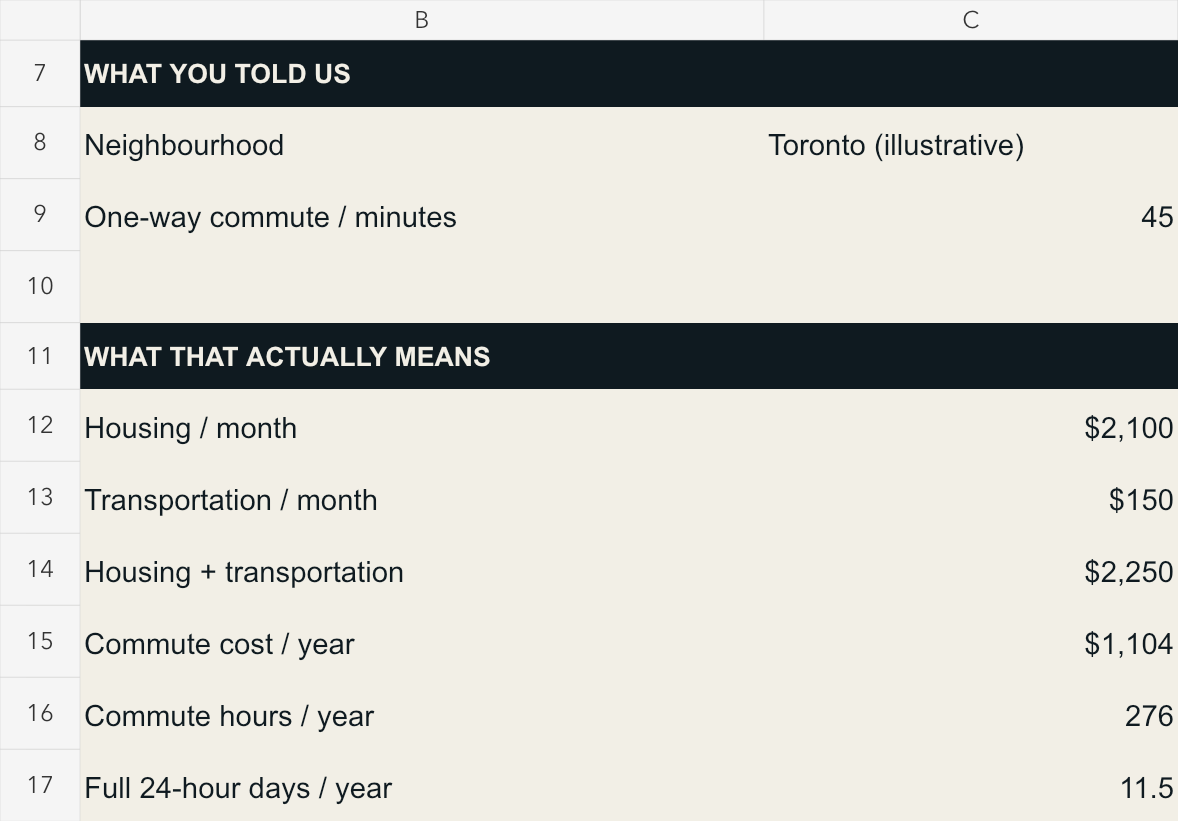
Toronto · Her Current Home
Winnipeg · A Home She Would Choose
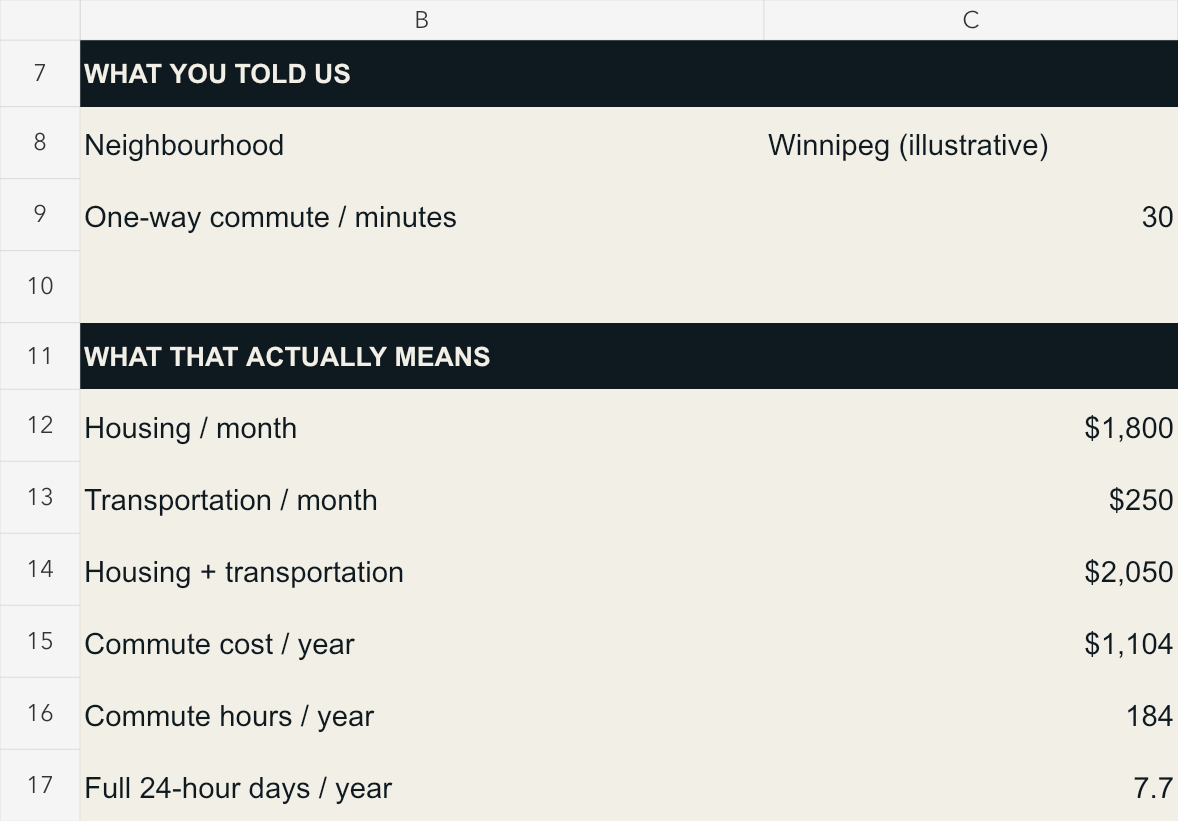
In this example, rent is $300 lower, but housing and transportation together cost $200 less per month. That is $2,400 a year before other budget changes. The extra $100 in transport costs uses up a third of the difference in rent.
There is a time difference too. A 30-minute commute in Winnipeg instead of 45 minutes in Toronto would give Maya back half an hour on each commuting day. With the work pattern shown here, that adds up to 92 hours a year. These are invented routes and budgets, but the exercise is real: compare what an address costs you in both money and time.
Someone searching for a new Toronto apartment could face a much larger gap. Someone sharing an inexpensive place might find a smaller one. The comparison that matters starts with the home you would otherwise stay in, or the one you would genuinely rent next.
There is another number Maya needs to look up: what returning to Toronto would cost. Leaving a good lease can make a move harder to reverse. Her old rent should not be the assumption in her backup plan.
Could She Find Her People Here?
Maya’s next question is whether she would enjoy living there. An attractions list is unlikely to settle it.
A place can have a gallery, a theatre and restaurants without any of them becoming part of your life. The more revealing question is whether you can find things you want to return to, and people you might gradually get to know there.
Winnipeg offers some concrete ways to do that. WAG-Qaumajuq currently has free Wednesday evening admission from 5 to 9 p.m. In the Exchange District, First Fridays opens participating galleries and studios each month. These are recurring invitations to go out, including when you haven’t yet built a group of friends to make plans with. WAG-Qaumajuq · First Fridays
For someone who would rather make something than browse it, Millennium Library’s ideaMILL includes sewing machines, recording facilities and other creative equipment, with access requirements varying by service. Winnipeg Public Library
None of this replaces Maya’s friends in Toronto. It does give her something more useful to investigate than whether Winnipeg has enough entertainment in the abstract.
Could she find a few places where she would eventually stop feeling new?
The Cheapest Apartment Might Be the Wrong Bargain
Once Maya starts comparing actual addresses, the decision changes again.
A lower-priced home farther from the activities she wants could leave her spending more time arranging rides, driving or deciding to stay home. A slightly more expensive apartment closer to those places might make the move work better.
That is a worthwhile use of a housing-cost advantage: being able to choose a location that helps you enjoy the city.
Transit is a particularly important address-level check. Winnipeg’s published network guidance lists Frequent routes at 10–15-minute intervals off-peak, while Community routes run every 30–60 minutes. Evening and weekend service can differ again. A bus stop nearby does not tell Maya how convenient her trip home will be. City of Winnipeg
She needs to look up the return journey after an evening out, as well as the trip to work. And she needs to consider whether she would still make that journey when waiting outside is unpleasant.
If moving would mean buying a car, that belongs in the comparison from the beginning. The cost extends beyond fuel to insurance, maintenance, parking and the vehicle itself.
A useful question is: how much of the rent saving would this address use up? Add utilities, trips back to see friends and any change in take-home pay. Keep one-time moving costs separate, then ask how long the remaining monthly saving would take to cover them.
Rent First, Get to Know the City
Maya doesn’t need to decide where she would buy before she knows whether she wants to stay. Renting first would give her time to learn which neighbourhoods fit her routine, how work develops and how often she wants to travel back to Toronto.
She can choose a rental that works for the life she wants now, then revisit ownership once she knows the city. For this decision, the useful comparison is the rent and everyday costs of two homes she would actually live in.
Ask the Second-Job Question
If Maya moves for a job, the offer helps answer whether she can afford to arrive. It does not fully answer whether she can afford to stay.
Who else hires people with her experience? Would the next role require another move? If she is keeping a remote job, has the employer approved the location, and what happens if that arrangement changes?
This is where “more affordable” becomes personal. A home that works beautifully on one income can feel different if the next suitable job is difficult to find.
Try an Ordinary Tuesday Before You Move
Before deciding, Maya needs to try an ordinary Tuesday in Winnipeg, not only a good weekend.
- Make the real trip. Start at the apartment, travel to work at the right time, then check the journey home after an evening out.
- Do an ordinary errand. Buy groceries and carry them home. Check the pharmacy, gym or other places you would use most weeks.
- Try something you would repeat. Visit a class, gallery evening or local gathering. Could this become part of your week, including when you have no one to go with yet?
She can use Rooofread’s Before You Move Here Excel template to test a neighbourhood against her actual routine. It brings together housing and transportation costs, a real commute, nearby everyday needs and observations from an after-work visit. The optional current-home comparison helps her use her own Toronto costs instead of a headline average.
She might discover that a particular address leaves her too dependent on a car. She might find a neighbourhood where she can afford the apartment and regularly do the things she enjoys. Either finding is more useful than deciding whether Winnipeg is broadly “worth it.”
So, Would It Feel Like Settling?
Winnipeg will not reproduce Maya’s Toronto life at a discount. The people, neighbourhoods and choices will be different, and some of what she values may be difficult to replace.
It can still offer a life she would actively choose. The housing advantage gives her a reason to look closely. What she finds beyond the listings determines whether she should stay interested.
By the end of the search, the most convincing sign may be that she has stopped saying, “Look how cheap this place is.”
She has started saying, “I could see myself living here.”
Methodology and Assumptions
Maya is an illustrative character. Her $2,100 Toronto rent and $1,800 Winnipeg rent are hypothetical, not live listings or city averages. The screenshots are cropped renders of Rooofread’s actual Excel template with those inputs. The commute and transport inputs are also hypothetical: 45 minutes each way in Toronto and 30 in Winnipeg; four commuting days per week for 46 weeks in both cities; $6 per round trip; other transport costs of $58 and $158 per month, respectively. The $6 is a modelling assumption, not a published transit fare. Neighbourhood observations are left blank because no visit has taken place.
Market rent figures are Statistics Canada’s experimental average asking rents for two-bedroom apartments in the Toronto and Winnipeg census metropolitan areas, Q2 2026. The $990 monthly market gap is $11,880 annually. Maya’s $300 monthly rent gap is $3,600 annually; a hypothetical $100 increase in transportation reduces that to $200 monthly, or $2,400 annually. The workbook calculates annual commute costs of $6 × 4 × 46 = $1,104 in each city, or $92 per month. Adding other transport gives $150 in Toronto and $250 in Winnipeg; housing plus transport totals $2,250 and $2,050. Annual commute time is 276 hours versus 184 hours, a difference of 92 hours. These are not complete household budgets. Income changes, utilities, moving costs, travel back and other expenses must be assessed separately. All dollar amounts are Canadian.
The illustration is conceptual, not a depiction of an identified apartment or venue.
Sources
Checked October 13, 2026. Recheck event hours, routes and any real listings before making plans. Market data may be revised.
- Statistics Canada, Table 46-10-0092-01. Q2 2026 average asking rent, two-bedroom apartments: Toronto CMA $2,650; Winnipeg CMA $1,660. Verified against the table’s CSV data.
- WAG-Qaumajuq: hours and admission. Free Wednesday admission, 5–9 p.m.
- First Fridays Winnipeg. Participating Exchange District venues on the first Friday of each month.
- Winnipeg Public Library: ideaMILL. Equipment, creative spaces and access requirements.
- City of Winnipeg: understanding the transit network. Published route-class guidance; actual route and trip schedules should be checked separately.