If you are waiting for construction cranes to tell you Courtenay, B.C., is changing, you may be watching too late. In this Vancouver Island city, a documented development-site acquisition, apartment proposals and planned infrastructure upgrades show how the next housing market starts taking shape before homes reach the listings.
For residents, this is a reason to pay attention now. Decisions about what gets built and which streets can support more homes could reshape parts of Courtenay over the next four to seven years. The effects may arrive gradually: construction nearby, more neighbours and, if projects reach completion, more places to rent or buy.
The projects below give that change a concrete outline. Their progress also shows why a land deal can precede a new housing option by years.
Courtenay has a concrete milestone ahead: a provincial target of 1,334 net new completed homes between September 2025 and August 2030. That is a delivery target, rather than a count of homes already approved or guaranteed to arrive. The City's longer-term housing needs assessment looks further ahead, identifying a need for 8,350 additional homes by 2041. These are separate measures with different purposes. City Of Courtenay Housing Needs And Targets.
Could Courtenay become a larger housing hub on Vancouver Island? Its development activity makes that worth watching. The test will be how much gets built, who can afford it and whether everyday services keep pace.
A Land Purchase Runs on a Different Clock
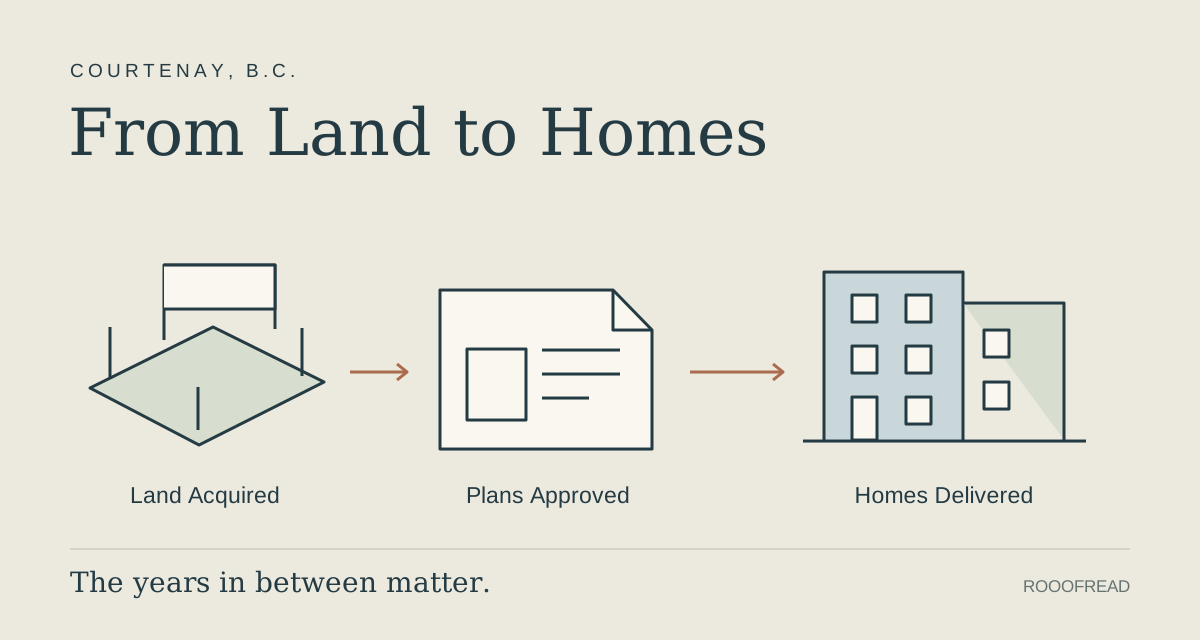
The Landing on 11th offers a local example. Pacific Swell says it acquired the site's original properties in fall 2023. In August 2024, it announced rezoning approval for a 104-apartment rental project. Its December 2025 update reported a building permit and the start of site work, with substantial completion anticipated in spring 2027. Pacific Swell Project Updates.
| Milestone | Developer's reported timeline |
|---|---|
| Original properties acquired | Fall 2023 |
| Rezoning approval announced | August 2024 |
| Building permit and site work announced | December 2025 |
| Substantial completion anticipated | Spring 2027 |
One project's reported timeline. The completion date is a developer estimate, not a confirmed move-in date.
If that schedule holds, roughly three and a half years would separate the original purchases from substantial completion. The acquisition itself did not put any of those apartments on the rental market.
That distinction matters when you hear that developers are buying land. A purchase signals an intention or opportunity. It does not establish the final number of homes, their tenure, their price or their delivery date.
What Happens Before the Building Goes Up
The process is more involved than buying land and waiting for one permit.
Zoning determines what can be built. A proposal that does not fit the existing rules may need a zoning amendment. Not every project needs rezoning.
A development permit deals with a different set of questions. Courtenay says these permits regulate matters such as building design, landscaping and parking, as well as environmental and hazard protection. They do not change the permitted land use or density. City Development-Permit Guidance.
Engineering and building approvals follow their own requirements. Servicing, detailed plans, permit review and inspections all matter. The City describes planning, building and engineering as distinct parts of its development process. Some work can overlap; the route depends on the site and proposal. City Development-Services Guide.
There is also the financial decision to proceed. Construction costs, borrowing costs and expected rental or sales revenue have to support the project. Approval alone cannot make that calculation work.
The acquisition-to-completion process can therefore take years. Calling that entire period a “permit delay” would miss the time spent assembling land, designing the project, arranging financing and building it. The Landing's timeline does not establish an average municipal processing time.
Courtenay's Pipeline Has Several Stages
There is already measurable delivery. The City's first housing-target report recorded 164 net new homes from September 2025 through February 2026, with most delivered by two major projects. Its March update also identified 295 units associated with issued building permits. Those were a pipeline snapshot at that time, not another 295 completed homes. March 2026 Council Update.
Other proposals are earlier in the process. A September notice describes a proposed four-storey, 34-home apartment building at 1201 and 1251 Braidwood Road, with initial rezoning readings scheduled for September 23, 2026. A proposal going before council belongs in a different category from a building ready for residents. City Public Notice.
The surrounding infrastructure matters too. Courtenay plans to replace aging water, sanitary and storm systems along Braidwood Road to support growth. Its published schedule points to fall 2026 through spring 2027, with dates still being confirmed. Braidwood Infrastructure Project.
For residents, that is one of the less visible parts of housing supply. More homes need functioning pipes and streets, as well as permission to build.
Vancouver Island Is Moving at Different Speeds
Construction is not accelerating everywhere on the Island at once.
CMHC recorded 574 housing starts in the Nanaimo metropolitan area from January through August 2026, up from 337 in the same period of 2025. In the Victoria metropolitan area, starts fell from 3,547 to 2,099. A housing start records construction beginning, rather than a finished home. CMHC August 2026 Construction Data.
| Metropolitan area | Jan.–Aug. 2025 starts | Jan.–Aug. 2026 starts | Change |
|---|---|---|---|
| Nanaimo | 337 | 574 | +70% |
| Victoria | 3,547 | 2,099 | −41% |
CMHC metropolitan boundaries. These figures are not municipal counts or a total for Vancouver Island.
Further north, Campbell River selected Seymour Pacific and Broadstreet for its Reimagine the Row redevelopment in December 2025. Preliminary designs included up to 200 rental homes above commercial and civic space, with further approvals and financing still part of the process. City Of Campbell River Announcement.
Together, these examples show different places moving through different stages. They do not prove that development money is leaving Victoria for Courtenay, or that Courtenay is about to overtake the Island's larger markets.
What Could Change for Renters and Buyers by 2033
For someone planning a future in Courtenay, B.C., the next four to seven years are best understood through conditions, rather than a single price prediction.
For renters, completed apartments could expand the shortlist. If available homes grow faster than demand, landlords may have to compete harder through pricing, incentives or lease terms. If demand keeps pace, the same construction may mostly accommodate additional households. New buildings can offer more choice without being affordable to everyone.
Courtenay's first six-month target report illustrates that problem: the City reported no below-market or affordable housing completions during the period. More market housing is useful, but it does not demonstrate that the lowest-income households are being served. City Progress Update.
For buyers, the type of housing matters as much as the total. A purpose-built rental building adds homes designed to be rented. It does not add the same number of condos for sale. Ownership choice depends on which projects offer homes for purchase, what they cost and what households can finance.
There is a broader risk behind both markets: softer demand can improve choice today while making the next project harder to launch. CMHC's 2026 outlook expects weaker rent growth and higher vacancies to slow rental construction nationally later in the year. That is a near-term national forecast, not a prediction for Courtenay in 2033. It explains why today's pipeline cannot simply be extended in a straight line. CMHC Housing Market Outlook.
For Courtenay to become a more useful housing hub, the change would need to extend beyond unit counts. Homes close to employment and services, reliable infrastructure and prices that work for local households would make the difference tangible.
Watch the Stage, Then the Price
If you are considering a move, ask where a nearby project actually sits: proposed, approved, permitted, under construction or ready for occupancy. Then ask whether its homes will be rentals or available to buy, and whether prices have been released.
For an existing neighbourhood, check the infrastructure plans alongside the building plans. For a future rental, compare actual available units and total monthly charges. For a purchase, assess what fits your household now without treating a promised development boom as guaranteed future value.
Courtenay's August 2030 housing target gives readers a milestone to follow. The time to pay attention is while those plans are being made, because decisions about density, servicing and housing types can shape a neighbourhood long before move-in day. By 2033, the meaningful story will be which plans have become homes people can use, and whether those homes have widened their choices.