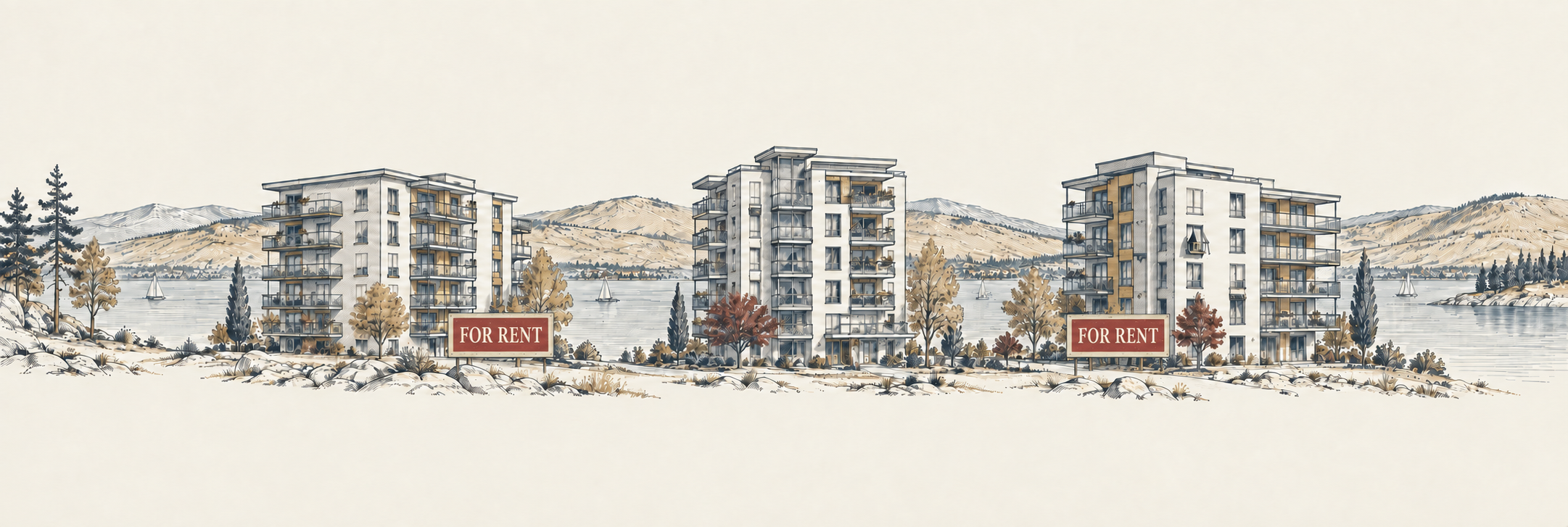
If you moved to Kelowna in 2022 or 2023, you remember what apartment hunting felt like. Showings with fifteen people in the hallway. Landlords asking for references, pay stubs and a cover letter. Signing for a place you'd seen for eight minutes because the next person in line would have.
That was the Kelowna rental market for most of the last twenty years. It isn't the market now.
Picture someone we'll call Maya. She's 32, works at the hospital, and signed a one-bedroom near downtown in the summer of 2024 at $1,950. Her renewal notice just came with the maximum allowed increase. Meanwhile, the building down the street has a banner out front offering a month free, and a one-bedroom on her own floor is listed for less than she pays.
Maya's question isn't "Is the market cooling?" She can see that it is. Her question is: What am I actually allowed to ask for, and what should I do?
That's what this piece answers.
In B.C., most fixed-term tenancies continue month to month when the term ends. You generally don’t need to sign a new lease to stay.
What Actually Changed
CMHC surveys Kelowna’s purpose-built rental market each October. In October 2023, the vacancy rate was 1.3%. In October 2024, it was 3.6%. By October 2025, it was 6.3%, among the highest of any major city in Canada.
Put simply: for every 100 purpose-built rental apartments in Kelowna last fall, about 6 were empty. Two years earlier, it was about 1.
A few things happened at once. A lot of new rental buildings finished; the number of purpose-built units grew from about 9,300 to about 10,700 in a single year. Fewer people were arriving, partly because of federal limits on international students and temporary workers. And since May 2024, B.C.'s short-term rental rules pushed many condos that used to be Airbnbs onto the long-term market.
Asking rents followed. The province's summary of the February 2026 Rentals.ca report showed two-bedroom asking rents in Kelowna down 10.8% from a year earlier. As of July 2026, Rentals.ca put average asking rents at about $1,808 for a one-bedroom and $2,248 for a two-bedroom.
But here's the part that catches people like Maya. CMHC’s same-sample rent measure rose 2.0%, even as asking rents softened. That measure includes tenant turnover; it doesn’t specifically measure increases for sitting tenants. So the market fell, and many sitting tenants' rent didn't. We wrote about how that gap happens in The Rent in the Ad Isn't Always the Rent for Your Apartment.
That gap is your opening.
Can You Ask Your Landlord to Lower Your Rent?
Yes. Almost nobody tells renters this, but in B.C. the rules limit how much a landlord can raise your rent: once every 12 months, with three full months' written notice, and no more than the yearly limit (2.3% in 2026, 2.2% in 2027). Nothing stops a landlord and tenant from agreeing to a lower rent. It just has to be in writing.
Your landlord doesn't have to say yes. But in a 6% vacancy market, it's a reasonable ask, and here's why it often works.
If you leave, your landlord's alternative isn't a lineup anymore. It's an empty unit for a month or two, a cleaning and repaint, listing and showing time, and a new tenant who will probably pay the current, lower asking rent anyway. A $100-a-month discount to keep a tenant who pays on time is cheap compared to that. Many landlords will do the math the moment you show them you've done it too.
How to ask:
- Find three comparable listings. Same size, same area, ideally your own building. Screenshot them with dates.
- Know your number. What would you take to stay? What would make you move?
- Ask in writing, early. Well before your renewal date, so there's time to look elsewhere if the answer is no.
- Keep it friendly and specific. "I'd like to stay. Similar units nearby are listed at $1,800. Would you consider $1,850 instead of the increase?"
The worst realistic outcome is the increase you were already going to get.
Free Month or Lower Rent? Take the Lower Rent.
Landlords love offering a free month because it makes the ad look good without touching the rent. For you, it's usually the worse deal, and hardly anyone explains why.
B.C.'s yearly increases are calculated on your rent, not on what you effectively paid. A free month disappears after year one. A lower rent stays with you and every future increase is smaller.
Here's the math on a two-bedroom (illustrative):
| Period | Option A: $2,250 with one month free | Option B: $2,100, no free month |
|---|---|---|
| Year 1 (you pay) | $24,750 (works out to $2,063/month) | $25,200 |
| Year 2 rent (2.2% increase) | $2,300/month | $2,146/month |
| Year 3 rent (assuming 2%) | $2,345/month | $2,189/month |
| Three-year total | about $80,490 | about $77,220 |
Option A looks cheaper in year one by $450. Over three years, Option B saves about $3,270, and the gap keeps growing every year you stay.
If a landlord offers a free month, try asking for the same value as a lower rent instead. If they won't budge, at least you'll know what you're comparing.
Is This a Good Time to Move to a Bigger Place?
This is the question almost nobody asks, and it might be the most important one for Kelowna renters in their 30s.
When rents are capped for existing tenants, the rent you start at becomes your base for as long as you stay. Moving in a soft market is like buying on sale: the discount travels with you for years. Moving in a hot market locks in a high base.
So if you've been putting off something because of housing, like moving in with a partner, getting a second bedroom for an office or a future kid, or moving closer to work so you can drop a car, a soft market is when it costs the least to do it.
Right now, the gap between an average one-bedroom and two-bedroom asking rent in Kelowna is about $440 a month. For a couple each paying for their own one-bedroom, a shared two-bedroom could free up well over $1,000 a month between them. For someone living alone, a second bedroom might cost less than it has in years. And a landlord with an empty two-bedroom may be willing to negotiate on it too.
The question to ask yourself isn't "Is rent cheap?" It's "Is there a move I've been waiting on, and would doing it now lock in a lower base?"
Could the Good Times End?
The leverage window is real, but it isn't guaranteed. Three things could shrink it.
Short-term rentals are coming back. Because its vacancy rate stayed above 3% for two years, Kelowna became the only B.C. city to opt out of the province's principal-residence rule for short-term rentals, effective June 1, 2026. Some condos that were rented long-term may go back to Airbnb. If you rent a condo from an individual owner, that's worth keeping in mind.
Building will slow. Developers respond to high vacancy by starting fewer projects. The units that pushed vacancy up in 2025 were planned years ago. If construction falls off faster than demand, today's surplus can turn tight again in a few years.
Your landlord might sell. Plenty of Kelowna condos are owned by investors who bought near the peak. If yours sells and the buyer wants to live there, B.C. rules require three months' notice and one month's rent in compensation. It's worth asking your landlord, casually, whether they plan to keep the unit.
What Could the Next Few Years Look Like?
The most likely path: another year or so of soft asking rents as recent buildings fill, then a slow firming as construction slows and short-term rentals take some units back. Nobody knows the exact timing.
For a renter, that points to a simple play. Use the leverage while it's here. Lock in the lowest base rent you can, because in B.C. the increase limit protects you on the way back up. If you've been waiting on a move, this might be the cheapest year to make it.
Your Checklist If Your Lease Is Up
- Check what similar units in your building and area are listed for today.
- Compare that to your rent plus the proposed increase.
- Decide your number to stay, and your number to move.
- Ask for a lower rent in writing, with listings attached, well before the deadline.
- If offered a free month, ask for the same value as a lower rent instead.
- If there's a move you've been putting off, price it now. Run your own numbers with What If I Keep Renting.
For the first time in a long time, "my lease is up" in Kelowna is a chance to save money instead of a reason to panic. It's worth one evening of research.
Methodology and Assumptions
Vacancy rates, average rents and unit counts come from CMHC's Rental Market Survey for the Kelowna CMA (October releases). CMHC's 2.0% figure is its same-sample change, which measures what existing units rented for year over year. Asking rents come from Rentals.ca, including the B.C. government's February 9, 2026 summary and Rentals.ca's July 2026 figures. CMHC’s summary covers vacant and occupied purpose-built rental units; Rentals.ca measures advertised rents across more housing types, so the two should not be compared directly. Rent increase limits and notice rules come from the B.C. government. The free-month comparison is illustrative: it assumes a 12-month lease, the 2027 limit of 2.2% in year two and 2% in year three, and that increases apply to the rent in your tenancy agreement. Maya is a composite, not a real person.
Sources & Notes
- CMHC Rental Market Survey, Kelowna historical summary
- Rentals.ca, Kelowna market page (July 2026)
- B.C. Government statement on February 2026 Rentals.ca report
- B.C. Government, rent increases (2026 and 2027 limits)
- B.C. Government, types of evictions
- CBC News, "Kelowna opts out of short-term rental limits after vacancy soars to more than 6%," April 17, 2026
- Castanet, "Short term rental opt-out granted in Kelowna" (June 1, 2026 effective date)
All figures should be read with their original reporting periods and definitions. This story is general information, not legal or personalized advice. Our editorial standards explain how we handle sources and corrections.