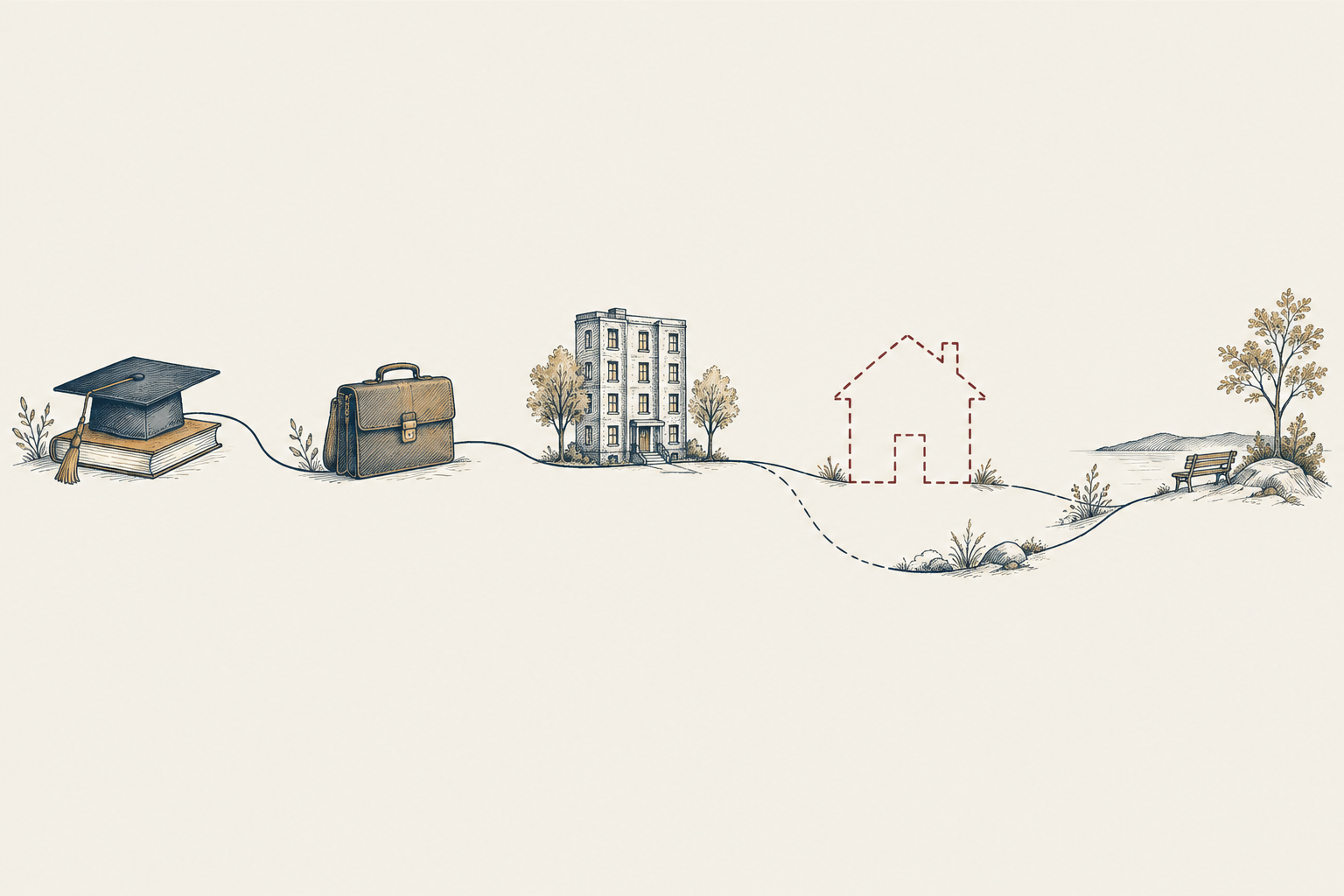
Somewhere around 31, a specific kind of math starts happening at dinner parties.
A friend mentions they just got pre-approved. You do the quick sum in your head: same program, same kind of job, similar salary. You both did the things. You got the degree, got the job, kept the job, stopped buying things you didn't need. So why is one of you touring townhouses and the other one renewing a lease on a one-bedroom with a view of the parking lot?
Nobody says it out loud, but the question underneath is: Did I miss a step?
Usually, you didn't. You were working from a map of adulthood that was drawn for a different housing market. Across Canada, the size of the gap changes from city to city, but the question is familiar. This piece is about that map: what it assumed, where it broke, the step it never listed, and how to figure out where you actually stand.
The Map Everyone Was Handed
Nobody sat you down and explained it. You absorbed it:
School. Job. Apartment. Partner. House. Kids. Car. Move up later.
The order wasn't random. Each step paid for the next one. A steady job made an apartment possible. A few years in the apartment, maybe with a partner splitting rent, built a down payment. The house came next because it was priced for people with steady jobs. Kids came after the house because now there was a second bedroom and a yard. The house built equity, and the equity paid for the move up.
Housing sat in the middle of that chain, holding it together. Pull it out and every step after it has to find another way to happen.
Statistics Canada measured how much it moved. Comparing people at the same age, 25 to 39: in Vancouver, 36.3% of baby boomers owned a single-detached house in 1991. In 2021, 12.2% of millennials did. In Toronto, the share fell from 32.7% of boomers to 19.4% of millennials at the same age. Nationally, after adjusting for adults still living with their parents, 49.9% of millennials aged 25 to 39 owned their home, compared with 56.2% of Gen X and 55.9% of boomers at the same age.
That's not a difference in taste. That's the middle of the chain slipping.
What It Looks Like in Real Life
The milestones didn't vanish. They came loose from each other. You've probably seen every one of these:
The couple with two good incomes who still rent. Two stable jobs, combined income that would have bought a detached house in 1995, and a lease that renews every August. Not because they can't manage money. Because a two-income household in 2026 is the baseline the market prices against, not an advantage.
The baby before the house. The old order said house, then kids. Plenty of people have flipped it, because fertility doesn't wait for a down payment. The average age of a mother at the birth of her child in Canada hit a new high of 31.9 in 2025, up from 26.7 in 1976. The window for kids and the window for buying now overlap, and people are choosing which one goes first.
The move back home at 29. In the 2021 census, 35% of Canadians aged 20 to 34 lived with at least one parent, up from 31% in 2001. For a lot of people, this is the savings plan. It just doesn't look like one from the outside.
The province swap. Leaving Vancouver for Calgary, Toronto for Halifax, the Island for the Interior. Not for a job. For a housing cost that lets the other milestones happen.
The condo that isn't a first step. You can technically afford a one-bedroom condo. But it isn't the home you pictured at this point, and the old promise that it's a stepping stone to something bigger depends on the next rung being within reach. In a lot of cities, the gap between rungs got wider than the stepping stone.
The long rental. CMHC's 2026 Mortgage Consumer Survey found 72% of first-time buyers were renting right before they bought, and they'd been renting for an average of 7.6 years. A year earlier, that average was 6.3 years. The apartment chapter isn't a chapter anymore. For many people it's most of the book.
None of these people are doing adulthood wrong. They're solving a different problem than the one the map was drawn for.
The Step Nobody Lists
Here's the part that explains a lot of those dinner-party moments.
The old map had no line for "family money." The new one does. It's just usually left off when people tell their story.
CMHC's 2026 survey found 27% of first-time buyers got a financial gift toward their down payment, with a median of $30,000 across all buyers who got one. One in four of the buyers who received a gift said they couldn't have bought a home that met their needs without it.
Statistics Canada's research goes further. It found that one in three homeowners under 35 got some kind of family support to enter the market, the highest share of any age group. It also cited research showing Canadians born in the 1990s whose parents owned a home were twice as likely to own one themselves by 2021 than those whose parents didn't.
And the gap it has to cover is big. In 2023, the median renting family under 35 had $12,000 in liquid assets. Even if they cashed out everything, they'd still be about $80,000 short of a 20% down payment on a typical home owned by people their age.
This isn't a reason to resent anyone. Most people would help their kids if they could. But it changes how you should read your friends' milestones. When someone your age buys, you're often not seeing the same sequence with better discipline. You're seeing a different sequence with an extra step in it.
Comparing yourself to that is like comparing your commute to someone who lives next to the office.
So Are You Actually Behind?
This is the question no one answers directly, so here's an honest attempt.
"Behind" only means something if you're measuring against a schedule. The schedule most of us are using is the old map, and the old map assumed a housing market that doesn't exist in most Canadian cities. Measured against that, almost everyone is behind, which means the measurement is broken, not you.
A more useful check is whether your housing is working for the life you're actually building. Try these instead:
- Is your housing cost stable enough to plan around? Knowing roughly what you'll pay in two years matters more than whether you own.
- Are you saving anything, on purpose, every month? Even if it isn't for a down payment. A renter with a steady savings habit may be in a stronger spot than an owner stretched to the limit.
- Is housing blocking a milestone you actually want? Not one you think you're supposed to want. If the answer is kids, a partner moving in, or a city you want to live in, that's the problem worth solving first. Our story on what living close to work is actually worth puts one of those trade-offs into numbers.
- Did you choose your trade-offs, or did they choose you? Commute, space, neighbourhood, flexibility. Everyone gives something up. The people who feel okay are usually the ones who picked.
If you can answer those well, you're not behind. You're on a different map.
What Decision Are You Actually Making?
"Can I afford a house?" sounds like one question. It's really three smaller ones, and you get to set the order.
Which milestone goes first? If buying is five years out, do kids, a move, or living together also wait five years? They don't have to. The chain is broken, which also means you're free to run it in the order that fits your life.
Which variable are you flexing? A smaller place, a different city, a longer commute, a longer time renting, a roommate or a sibling co-owner, a different kind of home. If you are comparing a smaller place with waiting, our five-year rent-versus-buy example shows why the answer changes with your assumptions. Nearly everyone in this stage of life is flexing at least one. The only bad option is pretending you aren't choosing.
What are you protecting? Stability, space, location or flexibility. Most people can lock in two comfortably and have to pay for the third.
There's no right answer. There's just a difference between making those trade-offs on purpose and drifting into them.
What Could the Next Few Years Do?
Some things are already moving. Asking rents have eased in several major markets, including Toronto, Vancouver and Calgary. Record rental construction is underway in cities like Halifax. Vacancy rates are climbing off their lows.
That won't redraw the old map. A cheaper rental doesn't hand you a down payment, and it doesn't erase the family-money gap. But it changes the math at the edges, and the edges are where your actual decisions live. If renting gets easier while buying stays hard, "rent well and build savings" becomes a real plan instead of a consolation prize. You can run your own five-year renting-versus-buying numbers instead of borrowing someone else's answer. If prices stay flat while your income grows, the gap narrows slowly.
The likeliest outcome is that the next few years won't fix the sequence. They'll keep rearranging it. The more useful move is to stop measuring yourself against the old one.
The Map Is Yours Now
It's strange to do everything in the right order and have the order not work. That feeling is reasonable. It isn't a personal failure, and it isn't a reason to treat your 30s as a waiting room for a life that starts at a mortgage.
The old sequence was never a rule. It was a description of a housing market that happened to exist when your parents were your age. What replaces it is a set of choices, city by city and household by household, about what home means now.
That's what Rooofread is for: what housing is doing to adulthood in Canada, and what you can do about it.
Methodology and Assumptions
Generational ownership comparisons use Statistics Canada's May 6, 2026 study of the 1991, 2006 and 2021 censuses (adjusted shares of people aged 25 to 39), the same figures used in our starter-home feature. Renting-before-buying and down payment gift figures come from CMHC's 2026 Mortgage Consumer Survey; the $30,000 median gift covers all buyers who received one, not only first-time buyers. Family support, liquid asset and down payment shortfall figures come from Statistics Canada's March 2025 study "Familial support in entering the Canadian housing market," which uses 2019 and 2023 Survey of Financial Security data; the down payment shortfall compares renting families' median liquid assets with 20% of the median home value of young homeowners. Age at childbirth is from Statistics Canada's September 23, 2026 release, "Fertility and baby names, 2025." Living-with-parents figures are from the 2021 census. The situations described are composites, not individual stories.
Sources & Notes
- Statistics Canada, "Millennials in the Canadian housing market," May 6, 2026
- CMHC, 2026 Mortgage Consumer Survey
- Statistics Canada, "Familial support in entering the Canadian housing market," March 26, 2025
- Statistics Canada, The Daily, "Fertility and baby names, 2025," September 23, 2026
- Statistics Canada, 2021 Census, "Home alone: More persons living solo than ever before," July 13, 2022
- CMHC, 2026 Mid-Year Rental Market Update, June 9, 2026
- CMHC, Fall 2026 Housing Supply Report, Halifax section
This story is general information, not personalized advice. Examples are illustrative. Source figures should be read with their original reporting periods and definitions. Our editorial standards explain how we handle sources and corrections.